fallen away?
but maybe that's just it
there's some fiery pit
that burns because all
your casting out
made it
Wednesday, February 27, 2013


Saturday, February 9, 2013
when you leave me (first)
when you leave me
first i do not
think
but
trace your still-warm spaces (indentations, marks, empty) on a circuitous route
i may unwittingly prepare
for a long
drought
storing substitutes in heavy pockets
i may hibernate
retreat to sleep under goosefeather fluff (the high as low as pillowed downs and just the window's light come in)
i may move
real
slow
or do the thing that's closest, like whatever my hand finds to touch (the loads of dishes, someone else's stuff)
i may
get stuck
that pile of papers, the messages, the clothes (whose job it was not mine to fold)
even the piano
i may eat
feeling unsatisfied
if I
am lucky I may
see something
a seed catalog with pink azaleas, seafoam nail polish, lavender bath salts, periwinkle stockings
or
that island candle I made a few weeks ago
and I will light it
but
I leave you
first
when my voice breaks
the sound barrier
- sk, 2/9/13
first i do not
think
but
trace your still-warm spaces (indentations, marks, empty) on a circuitous route
i may unwittingly prepare
for a long
drought
storing substitutes in heavy pockets
i may hibernate
retreat to sleep under goosefeather fluff (the high as low as pillowed downs and just the window's light come in)
i may move
real
slow
or do the thing that's closest, like whatever my hand finds to touch (the loads of dishes, someone else's stuff)
i may
get stuck
that pile of papers, the messages, the clothes (whose job it was not mine to fold)
even the piano
i may eat
feeling unsatisfied
if I
am lucky I may
see something
a seed catalog with pink azaleas, seafoam nail polish, lavender bath salts, periwinkle stockings
or
that island candle I made a few weeks ago
and I will light it
but
I leave you
first
when my voice breaks
the sound barrier
- sk, 2/9/13
Tuesday, January 22, 2013
the grand canyon (winewood dr)

like the clay
we used to get from thatabandoned rural construction pit
the rusty powdered ground
that pounded 'round our cotton Keds
the walls, big enough to fit
our tallest and most ballooned schemes
and how the massive concave bend pulled
our spinning bikes down in
and, skilled with sufficient speed,
barely pushed us up again
then afterward how that wet reddish muck
became the clods, the shoes
the pastels and chalks and rouges
whose soft edges I'd scrape
against every last pavement
or house
or office space
to home
whatever that is
-sk 1/22/13
Monday, January 21, 2013
poem: pond water

you take my hand against the animal
hot and damp
bristling up my thin wrist
plunged beneath
the murky pond water
glows browngreen and warm
gliding fast among
life-sized frogs
we dart and chase like
fat minnows
you admire the swell and lift of
my swabbed hair
the wedding will come soon
- sk 1/21/13
Thursday, December 20, 2012
In the Bleak Midwinter - voice, horn, ukulele, sleigh bells, piano

Dear friends near and far,
We wish you peace and joy this season and in the year to come. In lieu of a Christmas card, we share a song we've been working on late at night for the past few weeks. In the Bleak Midwinter (by Christina Rossetti and Gustav Holst), arranged with a dash of Antonín Dvořák, for piano, French horn, ukulele, sleigh bells, and voice. Arrangement, performances, and third verse lyrics by Scarlet K. Recorded and mixed by Alex. This is SK's first arrangement and AK's first venture in music production.
What we have we give you; we hope you'll listen and enjoy:
Merry Christmas and Happy New Year,
Brooklyn, NY / December 2012
Wednesday, September 5, 2012
The Grey Lady's Bent Ears
For lack of a better outlet, I point my personal songwriting blog to a matter of classical music business today.
Classical music critic Norman Lebrecht leaked news via his blog on Monday that fellow critic Allan Kozinn, who's been writing for The New York Times for the past 35 years, has been reassigned from his position as staff reviewer to the position of general cultural reporter. Citing internal politics, the reassignment was called a "demotion" and a General Cultural Outcry has ensued.
On a road trip at the time, I could contribute little from the passenger seat of our Subaru but I have a few observations, having worked closely with the Times' classical team as a pitching publicist in recent years.
The Times classical staff is arranged thusly: James "Jim" Oestreich (Classical Music Editor) assigns coverage and contributes essays and reviews, usually regarding music written before 1950. He is extraordinarily busy. Anthony "Tony" Tommasini (Head Classical Critic) negotiates coverage with Jim and specializes in opera/vocal music (usually written before 1900). Then there was Allan Kozinn, whose area of expertise covered standard repertoire (the older, more established works for those readers who are not in our little world) but whose knowledge of 20th and 21st century music is nearly encyclopedic, and who can write with equal passion and authority on The Beatles, John Cage, and C.P.E. Bach. Enter the free-lancers: Steve Smith (Music Editor of Time Out New York), whose knowledge of and curiosity about contemporary music parallels Allan's but he has far less autonomy over his assignments, let alone time; Vivien Schweitzer, whose area of expertise is piano music; and Zachary "Zack" Woolfe, who, like Tony, specializes in vocal music, especially opera.
OK. If Allan, who reportedly averaged (!) 5 concert reviews a week over 35 years, is removed, then the Times classical department is left with two staffers + three free-lancers. And the range of specialization is then traditional orchestral/chamber music (Jim), opera (Tony), opera (Zack), piano (Vivien), contemporary music of 20th + 21st centuries (Steve). What's curious to me is this: Does our city's "paper of record" need two specialists in opera and only a part-time contributor for 100+ years of contemporary music, spanning multiple epochs? From what I see, this staffing does not accurately reflect the cultural landscape which the paper of record is attempting to record.
Currently in NYC we have two major opera companies, neither of which has been delivering significant productions at breakneck pace. As a matter of fact, there have been numerous articles lamenting how very behind-the-times and inadequate NYC's big opera companies are compared to those around the world. Beyond that, Times has noted a very lively collection of upstart organizations presenting high-quality and/or grassroots opera/theatre works on a smaller scale. (Full disclosure: I work for one of them.) But even so, the Times — to this point — has seemed more transfixed by big houses, anyway. So?
Meanwhile, we are in a golden age of contemporary music in NYC. Composers and young performers are literally flocking to the city from all over the country, forming labels, collectives, ensembles, bands, festivals, and audiences at places like Roulette, Issue Project Room, (le) Poisson Rouge, Rockwood Music Hall. I almost can't get above 14th Street for all of the music happening below it and across the river. Brooklyn is some kind of independent musical capital of the world right now but are we seeing that reflected in our paper of record? Perhaps on the pop side, but with classical Allan has been the staffer who knows the current artists and who can contextualize this movement with 35 years of experience on the ground. Even with Allan, to me the balance of coverage happening Uptown versus Downtown (let alone across the river) hasn't seemed to be reflective of the current times. How much more so now that he's off the beat? Can one part-time free-lancer (Steve) really be the one only with his ear to the ground for 100+ years of music, including this current movement, while holding down the fort at Time Out? Or will the Gray Lady's ears become lopsided?
All of that said, I will also say this: I long for music writing that transcends the preview/review grind. From the perspective of a reader and also of one who pitches stories, I can attest that there are very few opportunities for a good story in print outlets. (Mark Swed? Anne Midgette?) Even if a critic is interested in the conversation at hand, writing an actual story (trend, news, or otherwise) rather than filling a review assignment amounts to working overtime. It's a critic's extra credit. Without the time and space for critics to start meaningful conversations in "official" print outlets, such conversations have largely moved onto legitimate blogs and webzines (George Grella The Big City, Frank J. Oteri NewMusicBox, Alex Ross The Rest Is Noise, Thomas Deneuville I Care If You Listen) and social media. I've read far more interesting insights and witnessed far more challenging discussions about the current state of contemporary/classical affairs via colleagues on Twitter and Facebook, or even on the personal blogs of such amateurs as myself. But with social media there is no lasting historical record. As far as having such discussions with the vast majority of staff critics who might have much knowledge and insight to offer? For me it's mostly off the record over lunch, or in an unprintable email. Too bad for all of us.
If Allan's new position as general cultural reporter fills that void — Can I be optimistic? — there might actually be interesting stories to read in a print daily about classical music, and set in broad cultural context.
Classical music critic Norman Lebrecht leaked news via his blog on Monday that fellow critic Allan Kozinn, who's been writing for The New York Times for the past 35 years, has been reassigned from his position as staff reviewer to the position of general cultural reporter. Citing internal politics, the reassignment was called a "demotion" and a General Cultural Outcry has ensued.
On a road trip at the time, I could contribute little from the passenger seat of our Subaru but I have a few observations, having worked closely with the Times' classical team as a pitching publicist in recent years.
The Times classical staff is arranged thusly: James "Jim" Oestreich (Classical Music Editor) assigns coverage and contributes essays and reviews, usually regarding music written before 1950. He is extraordinarily busy. Anthony "Tony" Tommasini (Head Classical Critic) negotiates coverage with Jim and specializes in opera/vocal music (usually written before 1900). Then there was Allan Kozinn, whose area of expertise covered standard repertoire (the older, more established works for those readers who are not in our little world) but whose knowledge of 20th and 21st century music is nearly encyclopedic, and who can write with equal passion and authority on The Beatles, John Cage, and C.P.E. Bach. Enter the free-lancers: Steve Smith (Music Editor of Time Out New York), whose knowledge of and curiosity about contemporary music parallels Allan's but he has far less autonomy over his assignments, let alone time; Vivien Schweitzer, whose area of expertise is piano music; and Zachary "Zack" Woolfe, who, like Tony, specializes in vocal music, especially opera.
OK. If Allan, who reportedly averaged (!) 5 concert reviews a week over 35 years, is removed, then the Times classical department is left with two staffers + three free-lancers. And the range of specialization is then traditional orchestral/chamber music (Jim), opera (Tony), opera (Zack), piano (Vivien), contemporary music of 20th + 21st centuries (Steve). What's curious to me is this: Does our city's "paper of record" need two specialists in opera and only a part-time contributor for 100+ years of contemporary music, spanning multiple epochs? From what I see, this staffing does not accurately reflect the cultural landscape which the paper of record is attempting to record.
Currently in NYC we have two major opera companies, neither of which has been delivering significant productions at breakneck pace. As a matter of fact, there have been numerous articles lamenting how very behind-the-times and inadequate NYC's big opera companies are compared to those around the world. Beyond that, Times has noted a very lively collection of upstart organizations presenting high-quality and/or grassroots opera/theatre works on a smaller scale. (Full disclosure: I work for one of them.) But even so, the Times — to this point — has seemed more transfixed by big houses, anyway. So?
Meanwhile, we are in a golden age of contemporary music in NYC. Composers and young performers are literally flocking to the city from all over the country, forming labels, collectives, ensembles, bands, festivals, and audiences at places like Roulette, Issue Project Room, (le) Poisson Rouge, Rockwood Music Hall. I almost can't get above 14th Street for all of the music happening below it and across the river. Brooklyn is some kind of independent musical capital of the world right now but are we seeing that reflected in our paper of record? Perhaps on the pop side, but with classical Allan has been the staffer who knows the current artists and who can contextualize this movement with 35 years of experience on the ground. Even with Allan, to me the balance of coverage happening Uptown versus Downtown (let alone across the river) hasn't seemed to be reflective of the current times. How much more so now that he's off the beat? Can one part-time free-lancer (Steve) really be the one only with his ear to the ground for 100+ years of music, including this current movement, while holding down the fort at Time Out? Or will the Gray Lady's ears become lopsided?
All of that said, I will also say this: I long for music writing that transcends the preview/review grind. From the perspective of a reader and also of one who pitches stories, I can attest that there are very few opportunities for a good story in print outlets. (Mark Swed? Anne Midgette?) Even if a critic is interested in the conversation at hand, writing an actual story (trend, news, or otherwise) rather than filling a review assignment amounts to working overtime. It's a critic's extra credit. Without the time and space for critics to start meaningful conversations in "official" print outlets, such conversations have largely moved onto legitimate blogs and webzines (George Grella The Big City, Frank J. Oteri NewMusicBox, Alex Ross The Rest Is Noise, Thomas Deneuville I Care If You Listen) and social media. I've read far more interesting insights and witnessed far more challenging discussions about the current state of contemporary/classical affairs via colleagues on Twitter and Facebook, or even on the personal blogs of such amateurs as myself. But with social media there is no lasting historical record. As far as having such discussions with the vast majority of staff critics who might have much knowledge and insight to offer? For me it's mostly off the record over lunch, or in an unprintable email. Too bad for all of us.
If Allan's new position as general cultural reporter fills that void — Can I be optimistic? — there might actually be interesting stories to read in a print daily about classical music, and set in broad cultural context.
Monday, July 9, 2012
Stranger to Blue Water / Grandma Doesn't Wear Underpants
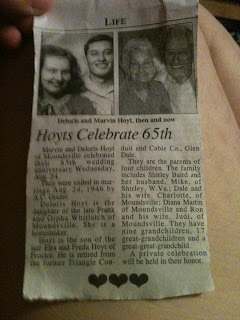
Deloris and Marvin met when she was 15 and he was 16. They married at 16/17 and had their first of four children, my mother, at 17/18. They would have been married for 66 years next month. (You know what they say about the secret to a long marriage? Don't get a divorce.)
Perhaps most people think of warm, soft grandmas who smell of cookies. That is my mom. But my grandma was "ornery." She loved roller coasters. Hated dogs but fed ours under the table just to drive my mother crazy. A diehard Pepsi fan, she drove across the Ohio border to buy her "pop" because she insisted it was fizzier there, and she told several of her offspring that she wanted a Pepsi can set on her grave. When I was ten she told me that there was no need for women to wear underwear to bed (because they'd just come right off anyway). An elder's wife in the fundamentalist Church of Christ sect, she sat silently in the back pew during worship and passed out Teaberry and Cloves gum to her grateful, naughty grandchildren.

Up until her sudden passing, she walked 5-10 "mile" a day, rain or shine, and she didn't want company. (Though I often forced my way in.) She was a private woman. She did not enjoy crowds or meeting new people. A true mountaineer, she gardened and baked while my grandfather hunted. (I once saw him shoot at a meddling groundhog out the window of his bedroom.) She canned more quarts of tomatoes, green beans, and garlic dill pickles than she and my grandfather could eat in a year. They raised pigs. When I was very little, I asked her where the pigs had gone and she pointed to my ham sandwich and said "You're eating them." (Horrified.)
Every year my family would drive seven hours to Moundsville, West Virginia, to visit. It was almost heavenly to cross the Blue Ridge Mountains and the Shenandoah River while singing along to "Take Me Home, Country Roads." There's one line that strikes me every time I hear it:
All my memories gathered 'round her
Miner's lady, stranger to blue water
Up until the age of about 60, my grandmother was a stranger to blue water. It was a trip to Virginia to visit my family that first brought Deloris to the big blue ocean, and she was smitten. It was the off-season, in October, when we walked along the beach and she helped me sneakily take off my shoes and socks to wade in the chilling water, against my mother's wishes.
I have some regrets. I never got to can with her. She kept telling me to hurry up and have babies so she could meet them. I don't know how to make her killer Amazin' Raisin Cake. I was racing along the highway to see her when she passed, so I didn't get to say good-bye. She and my Pap didn't come to my wedding, and I'm pretty sure it's because we had dancing and alcohol at the reception (though it wasn't compulsory!). I don't even know if she ever watched the fantastic wedding video Alex made to commemorate the occasion. I had also wanted her to come see New York City but she told me I was crazy, though I know she lay in bed at night listening to the news from NYC. She'd probably have hated the crowds. But it was always impossible to know with Grandma. She could have loved the Subway. She was unpredictable. Mercurial even.
For example, she did not want singing or music of any kind at her funeral. It was a closed casket, per her request, but I privately sang a few lines at her coffin anyway, in her own ornery spirit. And now, to really get her goat, I've recorded this old Church of Christ hymn in her honor. It was written in 1945, the year Deloris and Marvin met.
It's me x 3 + ukulele. Stick around for the second chorus, although Grandma probably wouldn't have.
If We Never Meet Again (by Albert E. Brumley)
Subscribe to:
Posts (Atom)


